I am a member of two writing critique groups – one, a subset of the larger group, is composed of five aspiring novelists. Both groups meet twice monthly to read each others’ work and offer feedback. The experience is immensely helpful in my journey to become a writer.
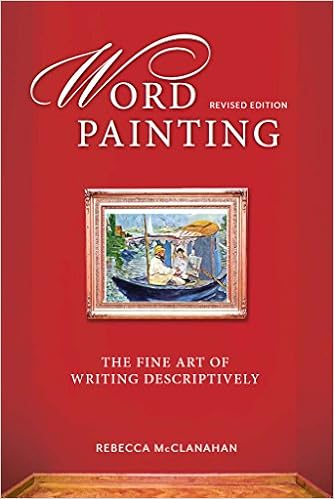
For our last two meetings I was especially interested in settings. I am beginning to notice more and more the importance of describing the scene. One of my colleagues gave me notes from a writing conference she attended in January, in which two separate sessions were devoted to setting the scene. One of the presenters referred to a craft book, Word Painting, for learning how to compose rich descriptions. l have not yet read the book, but even its blurb on Amazon gives marvelous insights into what one can do to improve.
One such insight is to become more observant. I think many people are prone to walking through life as if wearing blinders, unless reminded to pay attention to their surroundings. At my larger group meeting, a participant asked for resources for improving his writing of dialogue. One
suggestion was to go to a restaurant or coffee shop, sit off to the side, and observe people talking to each other – their gestures, pauses, expressions; how they take turns, interrupt. I thought that was spot on. As writers, we must truly be alive, fully open to seeing, feeling, and hearing the world around us. Only then can we hope to be able to find words to match.
After we find the right words we must know how to weave the resulting descriptions throughout whatever we are writing. I am in awe of the writers in my groups who make their work flow naturally. Reading a scene is like looking at a movie – words, actions, and reactions following seamlessly on each other and leading effortlessly one into the other.
Another conference presenter talked about using synesthesia to enrich our writing. According to Webster, synesthesia is “the production of a sense impression relating to one sense or part of the body by stimulation of another sense or part of the body”. In other words, we can mix and match our descriptions. Try writing about the taste of a table or the smell of a bowl. What does that pasta your heroine is about to eat sound like?
C.S. Lakin’s blog, LiveWriteThrive (livewritethrive.com), which I regularly follow, recently discussed allusion. This is another literary device that authors can use to bring a setting alive, describe it without being totally obvious, tell a vivid story. It is akin to giving the readers hints and allowing them to figure out the rest on their own, which, done skillfully, may draw them more completely into the action.
It can be a brilliant way to express or reinforce a theme. I am thinking of how I might use the name of the ship that takes my heroine to the new world or the name of the plantation that owns her, as an allusion to the theme of my novel – destiny.
And, since I brought that up, it’s time to get back to my editing. It will be my turn to read at the next critique session and I have to get copy out to the group members for feedback.
 The Plot Thickens
I appreciated this. Interesting, and nicely written, too. Almost made me wish I were writing a novel.
LikeLike
Thanks, Teri. I think you are my only reader!
LikeLike
Thanks for sharing these insights and reading recommendations. Also, I applaud your will and purpose-driven dedication at having a project that will not only enhance your life but will also bring art and upliftment to your readers. I say this not only in admiration. I note that my gumption is lacking these days. At night, I drum up some ganas to follow a writing path, too; but in the morning, I all too often slip into a lazy fugue and dream the day away.Okay, no more pity party. I appreciate your lessons learned. May I approach every task today with quiet impeccability
LikeLike