No, I am not paraphrasing a current racist political dog whistle. I am offering a commentary on it. The title of this post is in fact the title of a poem by a well-known African American poet, Langston Hughes. He wrote it in 1935 (!).
In a recent conversation with my daughter, Tara, the Busboys and Poets café came up. We frequented it when I lived in the U Street neighborhood of Washington, DC. She wondered about the name and I said I thought I remembered it having something to do with Langston Hughes. I recalled his having been a busboy and giving one of his poems to a recognizable literary figure whose table he was clearing. That person ultimately helped him launch his career.
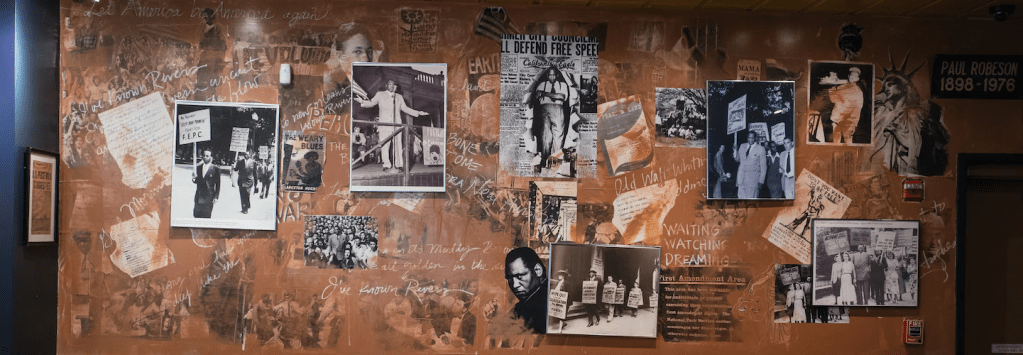
Technology always at the ready, even as we talked I Googled the café’s name. My recollection about the name was correct. Reading further, I discovered the restaurateur is also a painter and activist. His objective had been to create a space where people could mix and share ideas on art, culture, and politics. To make a physical statement of that aim, he created a mural on an entire wall of his flagship location at 14th and V Streets. The painting, entitled Peace in Struggle, depicts civil rights luminaries like Dr. Martin Luther King, Jr., Gandhi, and Nelson Mandela; and includes quotes from famous artists and leaders. The first few lines of Hughes’ poem is on at the top left edge of the page. You have to look carefully to see it.
When I read them, my neck, if it could have, would have swiveled on its base like an owl hearing a twig snap in the forest. The irony that words coined by a poet and civil rights activist and those conceived by Donald Trump (or his minions) are almost identical is obvious. That they were written eighty years apart grabs the attention. But what gobsmacked me after reading the entire poem (you can find it here https://poets.org/poem/let-america-be-america-again) was the utter clash of meanings and intentions.
Trump’s words look backwards to shape a not-so-subtle slogan. It calls for the return to an America in which smiling white women in TV commercials vacuumed floors while dressed in crinolines and high heels, Negroes knew their places (or at least pretended to at appropriate times), and the country otherwise ignored their existence (ten percent of the population in 1950).
Hughes’ words in contrast, look forward to voice a plea and a hope. They speak of the dream of an America that has yet to exist. They exhort us to bring the vision to fruition, while emphasizing the inherent lie we must overcome along the way.
Hughes begins:
Let America be America again.
Let it be the dream it used to be.
Let it be the pioneer on the plain
Seeking a home where he himself is free.
(America never was America to me.) (Lines 1-5)
. . . . . . ……………………………….
This structure continues throughout the poem’s eleven verses. They recount the many wonders and aspirations of the idea of America, alongside declarations of their subversion. Each verse ends with a version of the reminder, “America never was America to me.”
The third verse reads:
O, let my land be a land where Liberty
Is crowned with no false patriotic wreath,
But opportunity is real, and life is free,
Equality is in the air we breathe.
(There’s never been equality for me,
Nor freedom in this “homeland of the free”.) (11-16)
……………………………………………………………………………………..
My Dutch husband, from the objective viewpoint of one not born here, often marvels at my patriotism. He wonders why I don’t feel more of the sentiments Hughes expresses in these refrains. When merited, I am not loath to criticize this country, with all its faults and injustices – many with which I have personal acquaintance. And yet, I am always ready to defend it. I cried with Coach Doc Rivers when he mused, “Why do we keep loving this country when it does not love us back?”:
O, I’m the man who sailed those early seas
In search of what I meant to be my home—
For I’m the one who left dark Ireland’s shore,
And Poland’s plain, and England’s grassy lea,
And torn from Black Africa’s strand I came
To build a “homeland of the free.”
The free?
Who said the free? Not me? (47-54)
……………………………………………………..
For all the dreams we’ve dreamed
And all the songs we’ve sung
And all the hopes we’ve held
And all the flags we’ve hung,
The millions who have nothing for our pay—
Except the dream that’s almost dead today. (58-63)
Is it the seduction of such a pristine idea? The promise? Or maybe for the African American it’s an unconscious homage to the memory of all those black bodies who fed the oceans and enriched the soil we stand on, who built this dream as much as any planter who wielded a whip or violated a slave. We must remember them, avenge them. In my view, Hughes expresses this thought as both a threat…:
O, let America be America again—
The land that never has been yet—
And yet must be—the land where every man is free.
The land that’s mine—the poor man’s, Indian’s, Negro’s, ME—
Who made America,
Whose sweat and blood, whose faith and pain,
Whose hand at the foundry, whose plow in the rain,
Must bring back our mighty dream again. (64-72)
……………………………………………………….
From those who live like leeches on the people’s
lives,
We must take back our land again,
America! (75-78)
…and a promise:
O, yes,
I say it plain,
America never was America to me,
And yet I swear this oath—
America will be! (79-83)
Hughes’ writing was as enduring and prescient as it was current for the 1930s. That in itself is an indictment of the country’s shame. But what astonished me foremost about this final verse is how true the words ring, how specifically they apply to our America of 2020:
Out of the rack and ruin of our gangster death,
The rape and rot of graft, and stealth, and lies,
We, the people, must redeem
The land, the mines, the plants, the rivers.
The mountains and the endless plain—
All, all the stretch of these great green states—
And make America again! (84-90)
 The Plot Thickens
Kippenvel
LikeLike
Langston Hughes – 1902-1967…a right-minded globe-trotter & poet…, just like Chandlee…
Say, who are you that mumbles in the dark?
And who are you that draws your veil across the stars?
To Donald Tromp from the land of Maarten Harpertszoon Tromp (Den Briel, circa 23 april 1598 – Slag bij Ter Heijde (Scheveningen), 10 augustus 1653) :
From those who live like leeches on the people’s lives,
We must take back our land again,
America!
“Why do we keep loving this country when it does not love us back?
The plot thickens….Dickens!!
LikeLiked by 1 person
Thoughtful and very well written, Ms O. Thanks for your insights. 25 years ago, I was teaching for the Graduate School and my classroom was unavailable one evening (flooded). The Busboys & Poets you cited let me use a part of their restaurant for my class. One of my students knew of the Hughes connection and read that poem in class….a magical moment and moving memory. Andy
May I approach every task today with quiet impeccability .
LikeLiked by 1 person
Quite a story, Andy! I have fantasized about reading the poem in public. It’s so dramatic!
LikeLike
Like talking to you, which I miss. Well done, Chan. Love to you. Mary E.
LikeLiked by 1 person
I have never been to Busboys & Poets, but the next time I’m in DC, rest assured I will visit and revel in the words on the wall. I thought long and hard after reading the poem and your commentary. I agree. I also think that this country has taken two steps forward and three back in race relations. No, strike that. In human relations. We can and must do better.
LikeLiked by 1 person